Often referred to as the “Versailles of Morocco,” Meknes is the most understated of the country’s four Imperial Cities. While its neighbor, Fes, is famous for its labyrinthine medina, Meknes offers a more approachable and relaxed atmosphere, characterized by the massive walls and ambitious monuments commissioned by Sultan Moulay Ismail in the 17th century. Its history is one of grandeur and military strength, serving as the power center of the Alawite dynasty for over 50 years.
A day trip to Meknes is about more than just the city itself; it is a gateway to the region’s diverse historical layers. Within a short drive, you can transition from the intricate tilework of imperial gateways to the remarkably preserved floor mosaics of the Roman ruins at Volubilis and the sacred hilltop vistas of Moulay Idriss Zerhoun.
The Meknes region provides a comprehensive and rewarding experience and it is on our top 10 places to visit in Morocco.
Best Time to Visit Meknes
The best time to visit Meknes and its surrounding historical sites is during the Spring (March to May) and Autumn (September to November). During these shoulder seasons, the weather is mild enough for full days of outdoor exploration at the Roman ruins of Volubilis, while the city’s imperial plazas are pleasantly warm rather than scorching.
Spring (March – May) is the Most Scenic Season
Spring is widely considered the optimal time for a Meknes day trip. The surrounding Saiss Plain is lush and green, and the hills of Moulay Idriss are often covered in wildflowers.
Daytime temperatures typically hover between 20C and 25C (68F to 77F).
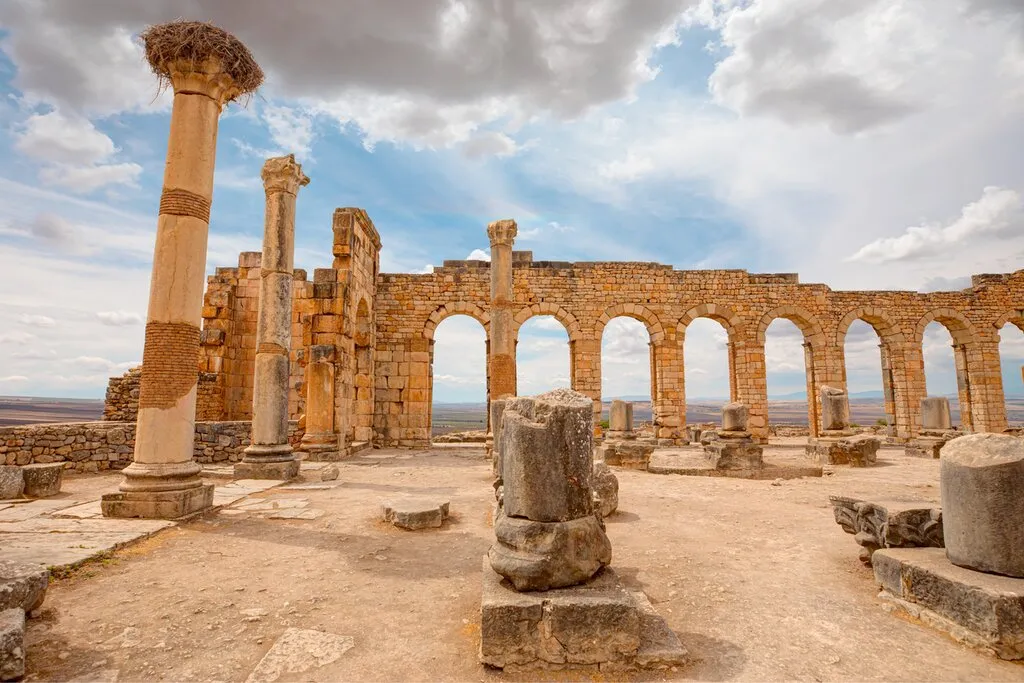
This is the best time for photography at Volubilis, as the green landscape provides a stunning contrast to the ancient stone columns.
Autumn (September – November) is the Cultural & Harvest Season
Autumn offers clear skies and comfortable temperatures, making it the preferred season for those interested in local culture and festivals.
September is traditionally the month for the Volubilis International Festival, which features traditional music and dance performances set against the backdrop of the Roman ruins. It is also the season for the local olive harvest—a staple of the Meknes region.
Weather is similar to spring, with warm days and crisp, cool evenings.

Imperial Landmarks and Public Squares of Meknes City Center
The heart of Meknes is defined by the monumental legacy of Sultan Moulay Ismail, who transformed the city into a fortified capital. Unlike the dense, winding alleys of Fes, the center of Meknes is characterized by wide open spaces and massive stone gates that speak to its military history.
Bab Mansour Gate
Considered one of the most beautiful gates in the world, Bab Mansour serves as the grand entrance to the Sultan’s former kasbah. Completed in 1732, the gate is famous for its intricate green and blue zellige tilework and massive marble columns, which were reportedly salvaged from the nearby Roman ruins of Volubilis. While the gate itself is often closed to preserve the interior, it remains the primary architectural symbol of the city and a focal point for photography.
El Hedim Square
Facing Bab Mansour is El Hedim Square, the vibrant cultural heart of Meknes. While smaller than Marrakech’s Jemaa el-Fna, El Hedim offers a more localized and less commercialized atmosphere. It serves as a bridge between the old imperial city and the medina. In the late afternoon, the square comes alive with street performers, storytellers, and local families. It is the ideal place to sit at a terrace cafe with a glass of mint tea to observe the rhythm of the city.
Mausoleum of Moulay Ismail
Located just beyond the grand gate, the Mausoleum of Moulay Ismail is one of the few active religious sites in Morocco that is open to non-Muslim visitors (excluding the actual prayer hall). The interior is a masterclass in Moroccan craftsmanship, featuring peaceful courtyards with fountains, finely carved stucco, and elaborate tilework. It serves as the final resting place of the Sultan who built the city and offers a quiet, spiritual contrast to the bustling markets nearby.
Architectural Marvels: The Prison, Stables, and Granaries
Beyond the public squares, the imperial city of Meknes contains a series of massive structures that illustrate Sultan Moulay Ismail’s obsession with scale and self-sufficiency. These sites were designed to withstand years of siege and represent some of the most impressive engineering feats of 18th-century North Africa.
The Underground Labyrinth of Habs Qara
Located beneath the plaza of the ambassadorial hall, Habs Qara (the Qara Prison) is a vast network of subterranean vaulted chambers. While popular legend describes it as a prison capable of holding 40,000 Christian slaves, most historians believe its primary function was a massive storage facility for the royal complex. Walking through the dimly lit, damp corridors provides a haunting sense of the scale of the Sultan’s “city beneath a city.” It is famously named after a Portuguese prisoner who was reportedly granted his freedom in exchange for designing the complex.
Heri es-Souani and the Royal Stables
A short distance from the mausoleum lies the Heri es-Souani, a colossal structure that combined a granary, a water wheel house, and a stable complex.
The Granaries
These massive silos featured walls nearly four meters thick to keep the interior temperature stable, allowing the Sultan to store enough grain to feed his army and horses for up to 20 years.
The Stables
Adjoining the granaries are the ruins of the royal stables, which once housed over 12,000 horses. Each horse reportedly had its own groom and slave. Today, you can walk through the seemingly endless rows of roofless stone arches—the roofs having collapsed during the Great Lisbon Earthquake of 1755—which remain one of the most photogenic ruins in Morocco.
Agdal Basin (Sahrij Swani)
Adjacent to the granaries is the Agdal Basin, an enormous stone-lined lake measuring over 300 meters in length. This reservoir served as both a pleasure lake for the royal court and a critical water source for the city’s gardens and hammams during times of drought. Today, it is a peaceful spot where locals go to walk and escape the heat of the medina.
To understand how these Imperial monuments fit into the wider timeline of the Kingdom, read our deep dive: From Roman Ruins to Imperial Splendor: A Journey Through Morocco’s Living History.
Volubilis – Morocco’s Roman Heritage
Located just a 30-minute drive from the Meknes city center, Volubilis is a UNESCO World Heritage site and the most well-preserved Roman archaeological site in North Africa. Once a thriving provincial capital on the fringes of the Roman Empire, it served as a critical supplier of grain and olive oil to Rome. Today, it stands as an expansive open-air museum surrounded by fertile olive groves.
The site is remarkably easy to navigate, with many of its primary public structures still standing:
The Basilica and Forum
Located in the city’s administrative heart, the Basilica’s high stone arches were once the court of justice and the center of commercial life.
The Capitoline Temple
Dedicated to the deities Jupiter, Juno, and Minerva, this temple sits on an elevated platform that offers one of the best panoramic views of the entire site.
The Triumphal Arch of Caracalla
Built in 217 AD, this iconic arch frames the Decumanus Maximus (the city’s main street) and the distant Zerhoun mountains.
The Famous Mosaics of Volubilis
What makes Volubilis truly exceptional is its collection of in-situ floor mosaics. Unlike many other Roman sites where mosaics have been moved to museums, here they remain in the original villas of the Roman elite.
- House of Orpheus. Features a stunning circular mosaic of Orpheus charming wild animals with his lyre.
- House of the Labors of Hercules. Depicts the twelve arduous tasks of the demigod in detailed panels.
- House of Venus. Contains some of the most delicate artwork on the site, including the “Abduction of Hylas by Nymphs” and “Diana Bathing.”
Moulay Idriss Zerhoun: The Sacred Hilltop Town
Just a few kilometers from Volubilis sits Moulay Idriss Zerhoun, a town draped across two hills that holds immense spiritual significance for Moroccans. It was here that Moulay Idriss I, a great-grandson of the Prophet Muhammad, arrived in the 8th century, bringing Islam to the region and founding the first major Moroccan dynasty.
The Sacred Atmosphere
For centuries, the town was closed to non-Muslims, but today it is a welcoming destination for all travelers. While the Mausoleum of Moulay Idriss I remains off-limits to non-Muslims beyond the main gate, the town itself is a maze of narrow, whitewashed alleys and vibrant green-tiled roofs.
Keep an eye out for the mosque in the center of town featuring the only cylindrical minaret in Morocco. It is decorated in striking green and white zellige tiles with calligraphic inscriptions from the Quran.
Follow the signs for the “Grande Terrasse” or “Petite Terrasse.” These vantage points offer a breathtaking look at the town’s dense architecture and, on clear days, a view of the Roman ruins of Volubilis in the valley below.
Local Life and Traditions
Because Moulay Idriss is a pilgrimage site, the town has a deeply traditional feel. The local markets are famous for their nougat and hand-pressed olive oil. It is the perfect place to pause for a traditional lunch after exploring Volubilis, offering a cooler, breezier environment than the plains below.

Planning Your Meknes Day Trip
Successfully navigating a day trip to Meknes and its surroundings requires a bit of logistical planning, especially if you intend to include Volubilis and Moulay Idriss Zerhoun in your itinerary. Most travelers use Fes as their base, given that the two cities are connected by a highly efficient and affordable rail network. Trains depart approximately every hour from the Fes Railway Station, and the journey takes only 35 to 40 minutes. Upon arriving at the Meknes Train Station (Gare Al Amir Abdul Kader), you are within a short taxi ride or a 15-minute walk of the Imperial City’s main gates.
Navigating the “Triangle”: Meknes, Volubilis, and Moulay Idriss
To see all three major sites in a single day, it is best to structure your journey as a “triangle.”
The most efficient method is to hire a private driver or a “Grand Taxi” for the day. If you are starting from Meknes, you can negotiate a flat rate—typically between 250 and 350 MAD—for a driver to take you to Volubilis, wait while you explore the ruins for two hours, stop in Moulay Idriss for lunch and panoramic views, and return you to Meknes in time for your evening train.
For those on a stricter budget, shared grand taxis operate from the ranks near the French Institute in Meknes. These taxis head to Moulay Idriss for about 15-20 MAD per seat; from there, you can take a shorter, 5-minute taxi or enjoy a scenic 45-minute walk down to the ruins of Volubilis.
Another option is to choose one of our private tours from Marrakech, during which you will have a chance to visit all four Imperial Cities (Marrakech, Fes, Meknes, and Rabat) plus the modern marvel of Casablanca.
Suggested Timeline
An ideal day trip begins early to beat the midday sun, particularly at Volubilis where there is no shade.
- 08:30 AM: Depart Fes by train.
- 09:30 AM: Arrive in Meknes and secure transport to Volubilis.
- 10:15 AM – 12:15 PM: Explore the Roman ruins of Volubilis.
- 12:30 PM – 02:00 PM: Lunch and viewpoints in the sacred town of Moulay Idriss.
- 02:30 PM – 05:00 PM: Afternoon in Meknes, visiting the Royal Stables, Granaries, and El Hedim Square.
- 06:00 PM: Return train to Fes.
Dining Recommendations
Meknes offers a variety of dining experiences that are generally more affordable than those in Fes or Marrakech. For a traditional Moroccan lunch with a view, Nagham Cafe near the square is a popular choice for its terrace overlooking Bab Mansour. If you are looking for a more formal architectural experience, Collier De La Colombe is located just a short walk from the square and is renowned for its traditional 7-vegetable couscous and its location within a beautiful former palace. For those who prefer a French-Moroccan fusion, the Bistrot Art & Le Wine Bar at the Hotel Transatlantique offers some of the best panoramic views of the entire medina from across the gorge.
A day trip to the Meknes region is essentially a journey through the layers of Moroccan history. From the Roman foundations of Volubilis to the spiritual heights of Moulay Idriss and the 17th-century imperial ambitions of Moulay Ismail, this area provides a density of heritage that is unmatched elsewhere in the country. By moving at a slightly slower pace than in the more hectic tourist hubs, you can truly appreciate the architectural and cultural milestones that helped shape the modern Moroccan state.