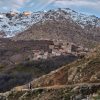
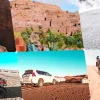
Stretching like a rugged spine across the Maghreb region, the Atlas Mountains are more than just a geological barrier separating the Mediterranean coastline from the immense Sahara Desert. They are a world of striking contrasts: snow-capped peaks rising above scorching dunes, lush cedar forests hiding endangered primates, and ancient mud-brick villages that have clung to the cliffsides for centuries.
Spanning approximately 2,500 kilometers (1,600 miles) through Morocco, Algeria, and Tunisia, this massive mountain range offers some of the most dramatic scenery on Earth. While the range extends across three nations, it is in Morocco that the mountains reach their most dizzying heights and offer the most accessible adventures for travelers.
From the summit of Jebel Toubkal—the highest peak in North Africa—to the red-earth valleys of the Anti-Atlas, this region is the heartland of the Amazigh (Berber) people. Here, hospitality is a way of life, and the landscape tells a geological story millions of years in the making.
Whether you are an intrepid trekker looking to conquer high-altitude summits, a culture enthusiast eager to explore UNESCO World Heritage Kasbahs, or a road-tripper seeking the winding curves of the Tizi n’Tichka pass, the Atlas Mountains promise an adventure that feels both timeless and wild.
While the Atlas Mountains can be explored independently, navigating mountain roads and arranging remote accommodation can be challenging. We specialize in crafting private tours around Morocco, that allow you to experience the majesty of the Atlas with complete peace of mind. Whether you have a single day or a full week, we have itineraries designed to connect you with the heart of this region.
Check out our 2-day tour from Fes to Merzouga via Atlas Mountains.
In this comprehensive guide, we will explore the geography, biodiversity, and cultural heritage of this majestic range, along with everything you need to know to plan your journey.
Quick Facts About the Atlas Mountains
- Location: Morocco, Algeria, Tunisia (North Africa).
- Highest Peak: Jebel Toubkal (4,167 m / 13,671 ft) in the High Atlas, Morocco.
- Primary Inhabitants: The Amazigh (Berber) people.
- Major Ranges: High Atlas, Middle Atlas, Anti-Atlas, Tell Atlas, Saharan Atlas.
- Best Time to Visit: Spring (March–May) and Autumn (September–November).
Geography and Geology: The Three Ranges of the Moroccan Atlas
While the Atlas system extends across the Maghreb, Morocco is home to its most significant and diverse sections. The mountains here are divided into three distinct parallel chains, running generally from southwest to northeast.

The High Atlas: The Roof of North Africa
This is the most famous and rugged section of the range, forming a massive weather barrier between the mild Atlantic coast and the arid Sahara Desert. It is the primary destination for serious trekkers and those seeking dramatic mountain scenery.
Key Characteristics
Sharp, jagged peaks, deep limestone canyons, and steep valleys dotted with terraced Berber villages. Snow is common on peaks from November to May.
Major Summits
Jebel Toubkal (4,167 m), the highest point in the Arab world, and M’Goun Massif (4,071 m).
Top Geological Features
The Todra and Dades Gorges, massive fault lines carved by rivers that are now top spots for rock climbing and photography.
Key Hubs for Travelers
Imlil
The main base for summiting Toubkal, located just 90 minutes south of Marrakech.
Ouarzazate
Known as the “Door of the Desert,” sitting on the southern slopes.
Ait Bouguemez
Often called the “Happy Valley,” a greener, more pastoral alternative for lower-altitude hiking.
The Middle Atlas: The “Switzerland of Morocco”
Located north of the High Atlas, this range surprises many visitors with its alpine appearance. It receives more rainfall than the other ranges, resulting in dense forests and lakes that feel more European than African.
Key Characteristics
Gentle slopes, cedar and oak forests, volcanic lakes, and chalet-style architecture. It acts as a vast water tower for the country’s agricultural plains.
Biodiversity Hotspot
This is the primary habitat for the endangered Barbary Macaque.
Top Geological Features: The Ouzoud Waterfalls (110 m high) located on the edge of the Middle Atlas are the spectacular result of geological faulting and river erosion.
Key Hubs for Travelers
Ifrane
A clean, modern town famous for its sloping roofs, university, and winter ski resort.
Azrou
A market town surrounded by the Cèdre Gouraud Forest, the best place to spot monkeys in the wild.
The Anti-Atlas: The Pre-Saharan Frontier
Running south of the High Atlas and bordering the Sahara, the Anti-Atlas is the oldest of the three ranges. Its landscape is stark, arid, and lunar, characterized by weathered rock formations and oases.
Key Characteristics
Dry, rocky terrain with strange granite boulders and hidden valleys filled with date palms and almond trees. It is much less crowded than the High Atlas.
Top Geological Features
The Ait Mansour Gorge, a stunning drive through a palm-filled canyon surrounded by reddish cliffs.
Key Hubs for Travelers
Tafraoute
A laid-back town nestled inside a valley of massive pink granite boulders.
Taroudant
Often called “Little Marrakech,” known for its impressive ramparts and souks without the intense hustle.

A Brief Note on Geology
The Atlas Mountains are a geologically complex system formed by the collision of the African and Eurasian tectonic plates.
- The Anti-Atlas is the oldest section (Precambrian/Paleozoic), eroded over hundreds of millions of years to its current rounded shape.
- The High and Middle Atlas are much younger, uplifted during the Alpine Orogeny (the same event that created the Alps and Himalayas).
- Fossils: Because the limestone rock of the High Atlas was once an ancient sea bed, it is common to find marine fossils (ammonites and trilobites) at high altitudes, particularly near Erfoud and the Dades Valley.
The High Atlas: Trekking and Summits
For many visitors to Morocco, the High Atlas is synonymous with adventure. This region offers some of the most accessible high-altitude trekking in the world, requiring little technical skill but a good level of fitness. The infrastructure for hiking here is well-developed, with a network of mule tracks connecting remote villages and mountain refuges.
Mount Toubkal: Climbing North Africa’s Highest Peak
Standing at 4,167 meters (13,671 ft), Jebel Toubkal is the primary objective for most trekkers. Unlike Kilimanjaro or peaks in the Alps, Toubkal can be summited in a relatively short timeframe, making it an ideal addition to a standard 10-14 day Morocco itinerary.
The journey almost always begins in Imlil (1,740 m), a bustling village often compared to Namche Bazaar in Nepal. From here, the standard route is a non-technical, uphill walk that usually takes two days.
Day one involves hiking up the Mizane Valley to the base camp refuges: the Toubkal Refuge (formerly Neltner) or Les Mouflons. These rugged stone lodges provide dormitory-style beds, hot meals, and a place to acclimatize at 3,207 meters.
Day two is summit day. Trekkers typically wake before dawn to navigate the scree slopes (loose rock) under headlamps. The ascent is steep and physically demanding due to the altitude, but the reward is a panoramic view that stretches from the Sahara Desert in the south to the plains of Marrakech in the north. The descent usually returns to Imlil on the same day.
While the trek is considered “non-technical” in summer, winter conditions (November to April) transform the mountain. During these months, the slopes are covered in snow and ice, requiring the use of crampons and ice axes. It is strongly recommended to hire a certified local guide for safety and navigation, regardless of the season.
The M’Goun Massif: The Remote Alternative
For hikers who find Toubkal too crowded or commercial, the M’Goun Massif offers a wilder, more isolated experience. The central peak, Ighil M’Goun, reaches 4,071 meters, making it the second-highest major summit in Morocco.
Trekking here is fundamentally different from Toubkal. The terrain is more varied, featuring dramatic ridges and deep, water-filled canyons. The famous “M’Goun Traverse” is a multi-day expedition that often takes 4 to 6 days. A highlight of this region is the Ait Bouguemez Valley, a fertile, green expanse dotted with traditional adobe architecture that serves as the trailhead for many expeditions.
The M’Goun trek is particularly famous for its river crossings. Hikers should be prepared to wade through the Oulilimt River, sometimes walking in the water for hours through narrow gorges. Because of the river levels, this trek is best attempted in late spring or summer.
How to prepare for trekking in Atlas Mountains?
Altitude sickness is a real risk in the High Atlas. Even though the ascent of Toubkal is short, the rapid gain in elevation can affect hikers. It is advisable to spend a night in Imlil or the nearby Aroumd village before starting the climb to help the body adjust.
Mules play a vital role in High Atlas logistics. They are the “4x4s” of the mountains, carrying backpacks, food, and supplies up to the snow line. Hiring a mule and muleteer not only supports the local economy but also allows hikers to walk with just a light daypack, significantly increasing the enjoyment of the trek.
Accommodation on the trail ranges from the large stone refuges on Toubkal to simple “gites d’etape” (guesthouses) in the villages. These guesthouses offer a genuine look into Berber life, providing home-cooked tagines and mint tea after a long day on the trail. Camping is also an option, particularly in the summer months and on longer traverses like the M’Goun circuit.
Read more about how to prepare for trekking in Atlas Mountains.
The Middle and Anti-Atlas: Forests and Deserts
While the High Atlas draws the most attention for its soaring peaks, the Middle and Anti-Atlas ranges offer distinctly different environments that are essential to a complete Moroccan itinerary. These regions serve as vital connectors for travelers moving between the imperial cities and the Sahara Desert.
The Middle Atlas: Cedar Forests and Alpine Lakes
Located north of the High Atlas, the Middle Atlas is a region of vast plateaus and dense woodlands. It is often described as the “Switzerland of Morocco” due to its cooler climate, peaked-roof architecture, and relatively high rainfall. The town of Ifrane exemplifies this European style. Built by the French in the 1930s as a hill station, Ifrane is clean, orderly, and home to Al Akhawayn University.
In winter, it becomes a hub for domestic tourism when snow falls, but for international travelers, it primarily serves as a refreshing stopover on the long drive between Fes and the Merzouga desert dunes.
Just south of Ifrane lies the Azrou Cedar Forest, part of the Ifrane National Park. This ancient woodland is home to the majestic Atlas Cedar (Cedrus atlantica), a tree endemic to the region that can live for hundreds of years. The forest is also the best place in Morocco to observe the Barbary Macaque in the wild. These primates are accustomed to humans and are frequently seen near the roadsides, though wildlife experts advise against feeding them to maintain their health and natural behaviors.
The Anti-Atlas: Granite Boulders and Argan Groves
To the south, bordering the Sahara, the Anti-Atlas offers a stark contrast to the green forests of the north. This is an arid, lunar landscape defined by intense heat and unique geology. The region is centered around the town of Tafraoute, which sits in a valley surrounded by massive, rounded granite boulders. The scenery here is surreal, highlighted by the famous “Painted Rocks”—a large-scale land art installation by Belgian artist Jean Vérame, who painted several giant boulders in shades of blue and pink in 1984.
The Anti-Atlas is also the exclusive home of the Argan tree. This thorny tree, which produces the kernels used for cosmetic and culinary oil, grows wild across the rocky slopes. Travelers driving through this region will frequently see women’s cooperatives dedicated to the labor-intensive process of cracking nuts and extracting the oil.
Culturally, the Anti-Atlas is distinct for its Agadirs (or Igoudar). Unlike the residential Kasbahs of the High Atlas, Agadirs are fortified communal granaries built on hilltops. These impressive stone structures were used by Amazigh tribes to store grain and valuables during times of conflict or drought.
The Agadir of Tasguent is one of the best-preserved examples, offering a glimpse into the region’s historical need for security and resource management.
Biodiversity: Flora and Fauna of the Atlas
The Atlas Mountains function as a unique biological bridge between Europe and Africa, creating a biodiversity hotspot that supports a mix of Mediterranean and African species. The variation in altitude and rainfall across the three ranges allows for distinct ecosystems to coexist, from the humid cedar forests of the north to the arid steppes of the south.
Mammals of the Mountains
The most iconic animal in the region is the Barbary Macaque (Macaca sylvanus). This is the only primate species found north of the Sahara and the only macaque found outside of Asia. While they were historically widespread across North Africa, their population is now concentrated in the Middle Atlas cedar forests and parts of the High Atlas. They are classified as endangered due to habitat loss and the illegal pet trade.
In the steeper, rockier terrain of the High Atlas, the Barbary Sheep, or Aoudad, can occasionally be spotted. These sturdy animals are adapted to precipitous cliffs and are known for their magnificent curved horns. They are elusive and best seen at dawn or dusk in remote areas like the Toubkal National Park. The lower, drier slopes of the Atlas are also home to Cuvier’s Gazelle, a species that has rebounded in numbers thanks to conservation efforts in reserves such as the Toubkal National Park.
Birdlife and Ornithology
For birdwatchers, the Atlas Mountains offer the chance to spot several endemic and rare species. The Moussier’s Redstart is a small, colorful bird found only in the Maghreb region and is frequently seen in open woodlands and rocky slopes. The high altitudes are the domain of large raptors. Golden Eagles and Bonelli’s Eagles use the thermal currents to hunt, while the rare Lammergeier (Bearded Vulture) can sometimes be seen circling the highest peaks, searching for bone marrow to scavenge. The Alpine Chough, a high-altitude crow species with a yellow beak, is a common sight around the refuges on Mount Toubkal, often scavenging for food scraps left by trekkers.
Flora and Vegetation
The vegetation of the Atlas changes drastically with elevation. The Atlas Cedar (Cedrus atlantica) is the signature tree of the Middle Atlas. These imposing conifers can grow up to 40 meters tall and provide essential timber and oil, though the forests are currently under threat from climate change and drought.
As the mountains transition into the semi-arid Anti-Atlas to the southwest, the vegetation shifts to the Argan tree (Argania spinosa). This UNESCO-protected biosphere reserve is unique to Morocco. The trees are incredibly resilient to heat and are the source of argan oil, a vital economic resource for the local Berber communities. In the spring months of March and April, the valleys of the High Atlas undergo a brief but colorful transformation as wildflowers bloom. Poppies, lavender, and wild scenic roses carpet the valley floors before the summer heat turns the landscape brown again.
Cultural Heritage in the Atlas Region
The Atlas Mountains are the ancestral home of the Amazigh (plural Imazighen), known to the wider world as the Berbers. While the term “Berber” is commonly used by tourists, the indigenous people prefer “Amazigh,” which translates to “Free People.” This population inhabited North Africa long before the arrival of the Arabs in the 7th century, and they have managed to preserve their language, culture, and traditions in the rugged isolation of the mountains. Today, travelers will notice the Tifinagh script—the geometric alphabet of the Tamazight language—displayed on road signs and schools throughout the region, a result of the language’s official recognition in Morocco’s 2011 constitution.
Architecture of Kasbahs and Ksars
The most defining visual feature of the Atlas region is its earthen architecture. The landscape is dotted with structures made from pisé (rammed earth) and adobe mud bricks, which blend seamlessly with the reddish-brown hues of the mountains. It is important to distinguish between the two main types of fortified structures found here. A Kasbah (or Tighremt) was historically the fortified mansion of a local leader or wealthy family, characterized by high walls and corner towers. A Ksar (plural Ksour), on the other hand, is a fortified village consisting of many attached houses surrounded by a collective wall to protect the community from invaders.
The most famous example of this architecture is the Ksar of Ait Benhaddou, a UNESCO World Heritage site located in the Ounila Valley south of the High Atlas. Its dramatic collection of earthen towers has made it a favorite location for filmmakers, appearing in Gladiator and Game of Thrones. These mud structures are incredibly effective at keeping interiors cool in summer and warm in winter, but they are also fragile. Without constant maintenance and re-plastering after the rainy season, they can dissolve back into the earth within a few decades, leaving behind the ghostly ruins seen throughout the Dades and Draa valleys.
Traditions and Village Life
Life in the High Atlas villages revolves around agriculture and the seasons. To survive in this vertical landscape, communities have carved elaborate terraced fields into the mountainsides, channeling snowmelt through intricate irrigation systems known as seguias. This allows them to grow barley, corn, apples, and walnuts at high altitudes.
Hospitality is a core pillar of Amazigh culture. Visitors to a mountain village are almost invariably welcomed with the traditional mint tea ceremony. This is not just a drink but a ritual of welcome, prepared with green tea, generous amounts of sugar, and fresh mint (or absinthe/sheba in winter). Handicrafts also play a vital role in the local economy, particularly carpet weaving. The geometric patterns found in Berber rugs are not merely decorative; they often tell stories of fertility, nature, and protection, serving as a form of visual language for the women who weave them.
Practical Information for Travelers
Planning a trip to the Atlas Mountains requires some strategic foresight, particularly regarding the seasons and transportation. Because the region spans such a vast area with varying altitudes, the “best” time to visit largely depends on what you intend to do.
Best Time to Visit
For most travelers, the ideal windows are Spring (March to May) and Autumn (September to November). During these months, the daytime temperatures are pleasant (typically 15°C to 25°C), making it perfect for trekking without the scorching heat of summer or the freezing conditions of winter. Spring is visually spectacular as the valleys are lush green and wildflowers carpet the slopes. Autumn offers clearer skies and crisp air, which is excellent for photography.
Summer (June to August) can be intensely hot in the foothills and Anti-Atlas, often exceeding 35°C. However, the High Atlas serves as a cool retreat; at altitudes above 2,000 meters, the air remains fresh, making it a popular escape for Marrakech residents. Winter (December to February) transforms the High Atlas into a snowy playground. While this makes general sightseeing difficult due to potential road closures, it is the prime season for winter mountaineering on Toubkal and skiing at Oukaïmeden.
Getting There and Around
The primary gateway to the Atlas Mountains is Marrakech Menara Airport (RAK). From Marrakech, the foothills of the High Atlas are visible and can be reached in as little as 45 minutes by car. For those targeting the Middle Atlas (Ifrane or Azrou), Fes-Saïss Airport is a more convenient starting point.
Public transport into the mountains is limited to buses that stop at major towns like Asni, so most travelers rely on one of three options: private transfers, “Grand Taxis,” or rental cars. Private transfers arranged by tour operators or hotels are the most stress-free method, particularly for navigating the winding mountain roads. Grand Taxis are shared old Mercedes sedans that operate on fixed routes; they are an inexpensive and authentic way to travel between towns, though they can be crowded. Renting a car offers the most freedom for road-tripping, but drivers should be experienced with narrow, precipitous roads and prepared for construction delays on passes like the Tizi n’Tichka.
Accommodation Options
The region offers a diverse range of places to stay, catering to every budget. On the luxury end, converted Kasbah hotels (such as Kasbah Tamadot or Kasbah Bab Ourika) provide opulent comfort with infinity pools and fine dining, often set in spectacular locations. For a more authentic experience, Gites d’Etape (village guesthouses) are widely available. These are simple, family-run homes that offer a clean bed, hot shower, and communal meals, allowing for genuine interaction with local Amazigh hosts.
For trekkers, accommodation on the mountain is functional. The refuges at the base of Mount Toubkal (Toubkal Refuge and Les Mouflons) are large stone lodges offering dormitory-style bunk beds. They are crucial for acclimatization but can get crowded, so booking in advance is essential. In the warmer months, wild camping is permitted in many areas, though it is best done with a guide who knows the safe and water-accessible spots.
Safety, Etiquette, and Guides
Travel in the Atlas Mountains, same as traveling in Morocco is generally very safe, but respecting local customs is vital.
The mountain communities are more conservative than the cities. Both men and women should dress modestly, covering shoulders and knees, particularly when walking through villages.
It is also polite to ask for permission before taking photos of people, especially women; in many cases, a smile and a polite gesture are enough to gauge if it is acceptable.
Certified Mountain Guide
Hiring a certified mountain guide is not just a safety recommendation; for summiting Mount Toubkal, it is now a legal requirement. Police checkpoints at the trailhead in Imlil often check that hikers are accompanied by a licensed local guide. These guides are trained in first aid and mountain safety, and their knowledge of the terrain and local culture adds immense value to the experience. Finally, cash is king in the mountains. ATMs are scarce outside of major towns like Asni or Ouarzazate, so always carry sufficient Dirhams for tips, snacks, and guesthouse payments.
Experience the Atlas with Our Private Tours
For us, Atlas Mountains are definitely one of the top 10 places to visit in Morocco.
For travelers with limited time, the High Atlas is easily accessible for a day of escape from the city heat of Marrakech.
We also offer The Great Desert Route (Marrakech to Merzouga). This is our signature multi-day road trip.
The journey from Marrakech to the Sahara Desert is not just a transfer—it is an exploration of the Atlas Mountains’ changing landscapes.
Unlike large bus tours, a private trip allows you to stop whenever you want—whether it’s to capture a sunset over a canyon or to drink tea with a local family we know along the route.